

Lookahead noise gate
Silentium
Silence between the storms — a tight lookahead noise gate for palm-muted rhythm.
AU · VST3 · Standalone · macOS & Windows · AGPL-3.0
About
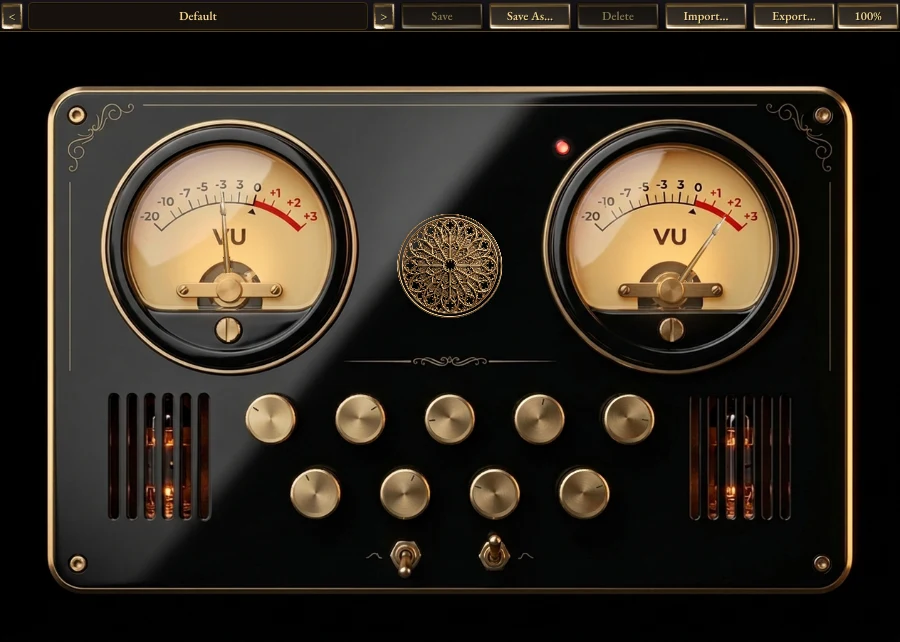
A tight, lookahead noise gate built to kill amp hiss and hum in the silence between palm-muted chugs: it detects transients on a sidechain-filtered copy of the input, opens fast with a lookahead head start so it never clips the leading edge of a pick attack, and uses separate open/close thresholds so a hovering signal can never chatter the gate.
Why the name?
Silentium is monastic silence: not the absence of sound, but its deliberate discipline. As a lookahead gate that is exactly what it enforces — silence between the notes, precisely when you demand it.
Under the hood
An expander whose neutral setting is the old code, not an approximation of it. Ratio runs a continuous downward-expander law between Threshold and Range — (Ratio − 1) dB per dB below Threshold, measured to within 0.25 dB at 2:1, 4:1 and 8:1, with a soft knee that is continuous in value and slope at both edges so widening it never introduces a corner. Range is the law's floor, not a second stage. And at the top of the range the gain computer branches to the literal pre-existing binary path, so "unchanged by default" is a code-level fact rather than a numerical coincidence.
A 0 ms attack that genuinely does not click. Smooth Open shapes the opening with a moving-max plus two cascaded box filters, all in the dB domain and all inside the existing lookahead window. A backward moving-max delays falls, not rises — so a rising edge passes it instantly and the box cascade spreads it linearly across the window, finishing exactly as the delayed transient leaves the delay line. Steepest step: 59.5 → 0.50 dB per sample, a 119× reduction, within 0.01% of the triangular kernel's theoretical peak. Reported latency at Lookahead 0, 2.5, 5 and 20 ms is identical with Smooth Open on and off. An earlier max(ballistic, smoothed) design was tried and rejected — at 0 ms attack the raw step wins the max and the click survives — which is why the smoother runs in series instead.
Lookahead you can move while the music is playing. The delay crossfades equal-power to its new length over 10 ms; the impulse verifiably moves from 240 to 480 samples with no re-prepare, and the largest sample-to-sample step through the transition is smaller than a fifth of a decibel. The new latency reaches the host from a 25 ms message-thread poll of a relaxed atomic — deliberately not an async update posted from the audio thread, which would take a lock and might grow an array. processBlock() allocates zero bytes even on the block where the lookahead moves.
Two detectors and two sidechain slopes, both always warm. The RMS detector (5 ms mean-square) and the 24 dB/oct Butterworth-Q-paired filter chain run every block, whether selected or not, so switching is a 5 ms or 10 ms crossfade between two live signals instead of a jump to a cold filter with a settling transient. Measured: 12.30 dB and 24.11 dB of rejection one octave below cutoff, against a theory of 12.3 and 24.1. On material with isolated spikes over a quiet bed, the peak detector opens the gate 99 times a second where RMS opens it not at all.
Neutrality proven against the previous version's own code. The test suite holds renders captured from a build of the prior engine before a single line of the new release was written, with full provenance — commit, compiler, host, flags, toolchain tag. A two-tier comparison keeps that honest across platforms: an always-asserted windowed level fingerprint at 2e-3 dB (cross-toolchain float noise lands at 1e-5; a real voicing change moves a window past 1e-2), and an exact SHA-256 check on the generating configuration where the toolchain matches. And the policy is proved non-vacuous: the same test asserts that a genuinely different Ratio setting must fail it.
Honest engineering, enforced by CI. 114 test cases and 9,156 assertions on macOS and Windows, plus pluginval at strictness 10 and auval -strict: zero heap allocations on the audio thread under a replaced allocator with every feature engaged, renders independent of host block size within 1e-6 RMS, exactly 0.0 output after ten seconds of silence, and an open gate that is still a pure delay to better than −120 dBFS with every new stage switched on at once.
Features
- Threshold with adjustable Hysteresis — 0–12 dB, defaulting to the 3 dB that was fixed before v0.4.0, so the gate can never chatter on a signal hovering near one value
- Lookahead — 0–20 ms head start so the gate never clips a pick attack; reported to the host as latency, and since v0.4.0 changeable live, crossfading over 10 ms
- Attack / Hold / Release — full envelope control (0–50 ms / 0–250 ms / 5–500 ms), with Exponential or Linear release shaping (v0.4.0)
- Range — floor attenuation down to −80 dB while closed
- SC HPF / SC LPF — sidechain-only high-pass and low-pass (v0.2.0), band-limit detection onto the pick-attack transient range and keep hum from falsely holding the gate open
- Knee — 0–24 dB soft knee, from classic hard snap to smooth gain blend
- Duck — inverts the gain computer into a ducker
- Listen — audition the sidechain detection signal
- External sidechain input — key the gate from another track
- Ratio — ∞:1 is a gate; turn it down and the same engine becomes a downward expander that thins a decaying note instead of switching it off (v0.4.0)
- Detector — Peak catches every pick attack, RMS measures energy over 5 ms so isolated clicks stop opening the gate (v0.4.0)
- SC Slope — 12 or 24 dB/oct on both sidechain filters, for a harder-edged detection band (v0.4.0)
- Smooth Open — shapes the opening into a ramp that fits inside the lookahead window, so even Attack at 0 ms opens without a step, at no extra latency (v0.4.0)
- Factory presets & preset management — browse/save/import/export via the in-plugin preset bar
Download
The latest builds are published on GitHub Releases.
The macOS binaries are Developer-ID-signed, notarised by Apple and stapled — they install and open without Gatekeeper warnings. Windows builds are not yet Authenticode-signed; SmartScreen may warn about an unknown publisher.
Compatible DAWs







Any modern DAW that supports VST3 or Audio Units. Pro Tools (AAX) is currently not supported.
Screenshots
Audio examples
Coming with the next release.
Before/after clips are being recorded — audio examples will appear here with an upcoming release.
Support development
Basilica Audio is free software, built at night and tuned by ear. If it earns a place in your session, you can help keep the candles lit.
Donation links are not wired up yet — they will go live soon.